
The 35% Deduction Cap: Why Top-Bracket Givers Get Less Back on Every Dollar in 2026
- J.T. Hardcastle

- Jul 13
- 6 min read

For most of the generous people I know, the charitable deduction has always worked in a pleasantly simple way. You give a dollar to a cause you love, and if you are in the top tax bracket, the government effectively covers thirty-seven cents of it. Starting with the 2026 tax year, that number quietly changes. The same dollar, given by the same donor, now comes back at thirty-five cents.
Two cents. On a single dollar, it barely registers. But generosity at the top of the income scale rarely moves one dollar at a time, and the 35% deduction cap is the kind of small change that compounds into real money once you scale it up to the way high-net-worth families actually give. I have spent a good deal of time lately sitting with the new charitable rules, and this one deserves a clear explanation, because it is easy to misread as either nothing at all or a reason to give less. It is neither.
The Two-Cent Haircut
Here is the mechanic in plain terms. The change comes out of the One Big Beautiful Bill Act, signed into law in July 2025. Beginning in 2026, if you are in the highest 37% tax bracket, the tax benefit of your itemized deductions is capped at 35 cents on the dollar rather than the full 37. Give $1,000 to charity, and instead of the deduction being worth $370 in reduced taxes, it is now worth $350.
The tax code gets there through a slightly technical route — it shaves your itemized deductions by a fraction tied to how far your income runs past the top bracket threshold — but the practical result is the one worth remembering. For a top-bracket donor, every deducted dollar is worth two cents less than it used to be. It is a haircut on the back end of your giving, applied after the gift is made.
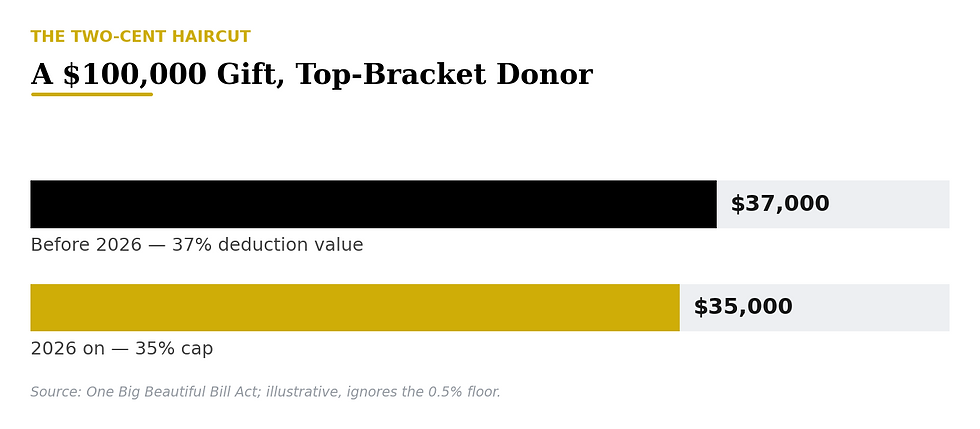
Scale that up and the shape becomes clearer. On a $100,000 gift, the two-cent difference is $2,000 of benefit that used to land in your column and now does not. A donor making a $500,000 gift in a single year gives up $10,000 of deduction value to the cap alone. None of this changes what the charity receives — the full gift still arrives — but it does change the after-tax cost of making it. For families who plan their giving deliberately, that cost is worth seeing clearly rather than discovering it on a return next spring.
The strategies here work differently for every situation, and the version that fits you is rarely the version a general article can describe. A Clarity Call is 30 minutes with a Partner — no pitch, no homework, just your numbers and the structure that fits them.
Curious what the cap does to your actual giving plan? Book a Clarity Call — 30 minutes, your real numbers, no pitch.
Who Actually Feels It
Before anyone reorganizes their entire giving plan, it helps to know whether the cap even applies to you. It is narrower than a lot of the early coverage made it sound.
The 35% cap only touches the top 37% bracket. In 2026 that bracket begins at roughly $640,000 of taxable income for single filers and about $768,000 for married couples filing jointly. If your income sits below that line, the cap does not reach you at all — your charitable deduction is worth the same as it was before. This is a rule for genuinely high earners, and even then, it only bites on the income and deductions that fall inside that top band.
For the donors it does reach, though, it rarely arrives alone. The same law also created the 0.5% floor, which erases the deduction on the first half-percent of your adjusted gross income you give each year. So a top-bracket family can lose a slice on the front end to the floor and a couple of cents on every remaining dollar to the cap. Neither change is dramatic on its own. Stacked on the same gift, they add up to a real trim in the tax efficiency of giving cash directly — which is exactly the situation that makes it worth understanding the full shape of the 2026 rules before you write your next big check.

I want to name something here, because it matters. The deduction has never been the reason to give. The generous families I work with would keep giving if it vanished entirely — the deduction is a tailwind, not the engine. But stewardship means paying attention to the mechanics, and when the mechanics shift, the wise move is to adjust the plumbing, not the heart.
Why the Deduction Isn't the Whole Story
Here is the part that gets lost when people read the 35% cap as a reason to pull back. The cap only touches one of the two tax benefits of a charitable gift. It does nothing to the other one — and for high-net-worth donors, the other one is often the larger prize.
When you donate an appreciated asset — long-held stock, real estate, a slice of a business — instead of cash, you get two distinct tax advantages. You get the deduction for the fair market value of the gift, and you avoid the capital gains tax you would have owed if you had sold the asset first. The 35% cap trims the first benefit by two cents on the dollar. It leaves the second one completely untouched.
That changes the math in a quiet but useful way. As the deduction on a cash gift becomes worth a little less, the capital-gains avoidance on an appreciated gift becomes a proportionally larger share of the total tax benefit. A donor who was on the fence about the extra paperwork of gifting stock rather than writing a check now has one more reason to make the move. This is precisely why funding a gift with an appreciated asset is worth more relative to the cash alternative than it was a year ago. The cap did not shrink generosity. It shifted where the efficiency lives.
It is also worth remembering that the 35% cap is not a charitable rule at all — it applies to your itemized deductions as a whole, including state taxes and mortgage interest. That broader reach is a reason to be strategic rather than discouraged. When the value of every itemized dollar is trimmed at the top, the deductions you can control the timing of — and charitable giving is the most flexible of them — become the ones worth planning around. You cannot move when your property taxes come due. You can absolutely choose the year, the asset, and the vehicle for a major gift.
Three Ways Top-Bracket Givers Give Smarter in 2026
If you are in the bracket the cap reaches and you want something concrete to do about it, here is where I would start.
1. Give appreciated assets before you give cash. This is the single highest-leverage move under the new rules. The capital-gains tax you sidestep by donating stock or property directly is untouched by the 35% cap, so more of your total tax benefit survives the change. If your giving is currently running on cash, that is the first habit to revisit.
2. Use a donor-advised fund to bunch and time your gifts. A donor-advised fund lets you separate when you take the deduction from when your charities receive the money. Concentrating several years of giving into a single funding year clears the annual floor decisively and lets you place a large deduction in whichever year your income makes it most valuable. The new rules made this timing discipline worth more, not less — one reason a DAF has quietly become more valuable under the 2026 law, not obsolete.
3. If you are over 70½, look hard at the QCD. A qualified charitable distribution moves money straight from your IRA to a charity. It never becomes taxable income and it never becomes an itemized deduction — which means the 35% cap and the 0.5% floor cannot touch it. For older donors with retirement assets, it is one of the few giving routes the new limits leave entirely alone.
None of these require a complicated structure or an estate attorney on retainer. They require looking at the new rule honestly and giving with a little more intention than the old code asked of us.
The 35% cap is not going to make generous people less generous, and it should not. What it does is reward donors who pay attention to how they give, not just how much. The families who route their giving through appreciated assets, thoughtful timing, and the right vehicle will barely feel the change. The ones who keep writing cash checks on autopilot will hand the tax code a little more than they need to. The difference between those two outcomes is not more money. It is a few minutes of planning, put in on purpose.
Every household's numbers land in a different place, and the version of this that fits you is rarely the version a general article can describe. The conversations that turn "interesting article" into "actual plan" happen one set of numbers at a time.
Wondering what the 2026 rules mean for your giving? Let's look at your numbers together.
J.T. Hardcastle is a Partner at Sage & Main who helps families and business owners align their wealth with their values through tax-smart planning and intentional generosity.



Comments