How a Donor Advised Fund Actually Works (Without the Jargon)


There are now more than 3.56 million donor advised fund accounts in the United States, holding upwards of $326 billion earmarked for charity. That's a remarkable amount of money sitting in a tool most people can't actually explain. Ask around and you'll hear half-answers: it's a tax thing, it's for billionaires, it's complicated. None of that is quite right.
So let's clear it up. Here's how a donor advised fund actually works, without the jargon — what it is, what it does to your taxes, and the short list of things it's genuinely good at and genuinely bad at. By the end you'll understand it well enough to decide whether it belongs in your own giving.
The simplest way to picture it
A donor advised fund is a charitable account. You open it at a sponsoring public charity — a national one like Fidelity Charitable or National Philanthropic Trust, a local community foundation, or a faith-based foundation. Once it's open, the whole thing runs on three moves.
- You give. You move money or assets into the account. The moment you do, it's an irrevocable charitable gift, and you get the tax deduction that year. - It grows. The money is invested while it waits. Any growth happens tax-free, which means more dollars eventually reach the causes you care about. - You grant. Whenever you're ready — this month, this year, ten years from now — you recommend grants to the churches, ministries, and charities you want to support. The sponsor cuts the checks.
A helpful way to hold it in your head: a DAF is a kind of charitable savings account. You fund it once, let it sit and grow, and then give it away in pieces on your own schedule. The key word in the name is advised — you don't legally own the money anymore, but you advise where it goes, and reputable sponsors follow that advice as a matter of course.
Picture a couple who sells a long-held block of stock — or rather, doesn't sell it. Instead they move $100,000 of that appreciated stock straight into a donor advised fund. They take a deduction this year, while their income is high. The sponsor sells the stock with no capital gains tax owed, invests the proceeds, and over the next several years the couple recommends grants of $15,000 to $20,000 a year to their church and two ministries they love. One contribution, one deduction, years of giving. That's the whole rhythm.
The piece that surprises people most is the timing split. You can take the full deduction in a year that you contribute, even if the charities don't see a dollar until years later. That gap between when you give and when you grant is the entire point. It lets you separate the tax decision from the giving decision, so neither one is rushed.
Why it beats writing a stack of checks
If a DAF only moved your giving into an account, it wouldn't be worth the paperwork. What makes it worth understanding is the tax math underneath.
Start with the deduction. When you contribute, you claim a charitable deduction that same year — useful when your income spikes, when you sell a business, or any year your tax bill is higher than usual. For 2026, you can deduct cash gifts up to 60% of your adjusted gross income, and gifts of appreciated assets up to 30%, carrying anything extra forward for up to five years.
Then comes the move most donors miss. Instead of giving cash, you can fund the account with appreciated stock you've held more than a year. When you do, you deduct the full fair market value and skip the capital gains tax you'd owe if you sold it yourself. The charity, being tax-exempt, sells it without owing that tax either. The same gift costs you noticeably less.
Two recent rule changes make a DAF more useful, not less. Starting in 2026, the One Big Beautiful Bill Act lets itemizers deduct only the giving that exceeds 0.5% of their adjusted gross income, and it caps the value of each deducted dollar at 35 cents for top-bracket donors. Scattered annual gifts now clear that floor over and over, losing a little each time. Bunching several years of giving into one DAF contribution clears the floor once, captures the deduction when your rate is highest, and still lets you grant to your charities on the old schedule.
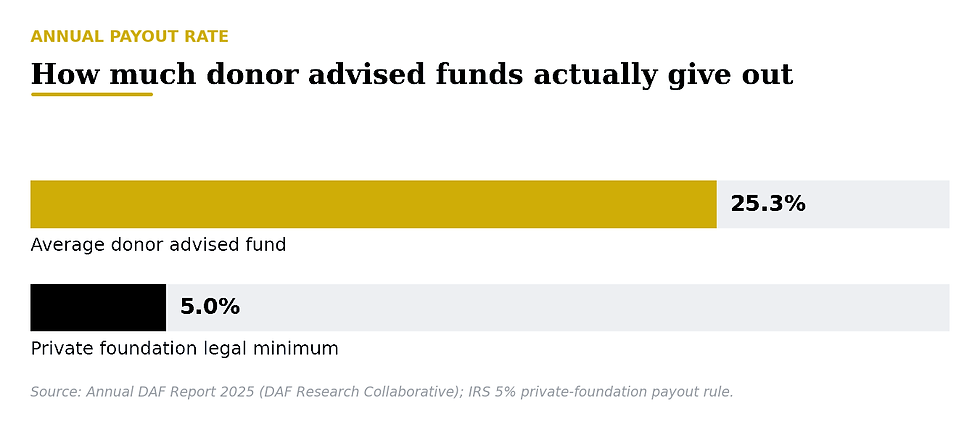
People worry that money parked in a DAF just sits there. The data says otherwise. The overall payout rate from donor advised funds was 25.3% in the most recent annual report — roughly five times the 5% that private foundations are legally required to distribute, and DAFs carry no such requirement at all.
Seeing how the deduction, the capital gains savings, and the timing stack up on your actual return is the part worth getting right. That's exactly what a Clarity Call is for — 30 minutes with a Partner, your real numbers in front of us, no pitch.
Book a Clarity Call — 30 minutes. No pitch. Just your numbers.
What it's good at — and what it isn't
A DAF is a tool, and like any tool it fits some jobs beautifully and others poorly. Knowing the difference saves you from forcing it.
It's genuinely good at a handful of things. It turns appreciated stock, mutual funds, and sometimes business interests or real estate into giving without a tax hit on the gain. It makes bunching simple. It lets you give quietly, since grants can be made without your name attached. It keeps your giving organized in one place instead of scattered across a year of separate checks. And it's one of the cleanest ways to involve your family — you can name a spouse or your children as advisors now, and a successor to keep the giving going later, which raises the question of what happens to the money still in the fund when you're gone.
It also has firm limits, and they trip people up. The contribution is irrevocable — once it's in, it belongs to charity, full stop. You can't use a DAF to get anything of personal value, so it can't buy your table at the gala or your tickets to the banquet. Grants go only to qualified public charities, not to individuals or political campaigns. And not every DAF is run the same way; sponsors differ on fees, investment options, and how they handle complex assets, so the one you choose matters.
The sponsor question is worth a moment. A national sponsor tied to a brokerage tends to be low-cost, fast, and easy to fund with stock. A community foundation brings local knowledge and grant expertise in your own city. A faith-based or Christian foundation can align the account's investments and grantmaking with your convictions. Most charge an annual administrative fee in the neighborhood of 0.6% of assets, plus the investment costs underneath — modest, but worth comparing before you open one.
For larger or more complicated giving, a DAF is often the starting point of a comparison rather than the final answer. Families wanting more control sometimes weigh it against a private foundation, which comes down to four questions about control, cost, and privacy. Those planning around an estate may compare it to a charitable trust to see which structure actually fits. And donors who want their generosity to also protect their heirs sometimes pair a DAF with whole life insurance so they can give boldly without shortchanging the next generation.
The jargon was never the point
Strip away the acronym and a donor advised fund is a simple idea: give once, in the most tax-smart way you can, then take your time deciding where it goes. The complexity people fear is mostly vocabulary. The mechanics are easy enough to explain over coffee.
What the tool can't do is supply the heart behind it. "Each one must give as he has decided in his heart, not reluctantly or under compulsion, for God loves a cheerful giver" (2 Corinthians 9:7, ESV). A DAF doesn't decide that part for you — it just makes the deciding cleaner, the giving more efficient, and the whole thing easier to keep going for years. If you've been writing checks every December and wondering whether there's a wiser way to do it, now you know there is. The next step is simply seeing how it maps onto your own numbers.
Every donor's situation is different, and the version of this that fits you is rarely the version a general article describes. The conversations that move people from "interesting idea" to "actual decision" happen one-on-one — your numbers, your values, an honest read.
Book a Clarity Call — 30 minutes with a Partner. No pitch. No homework.


Comments