What Happens to Your Donor Advised Fund When You Die?

Updated: Sep 21

A friend of ours spent fifteen years building a donor advised fund. Every December he moved appreciated stock into it, took the deduction, and spread grants across the ministries and causes he loved. He was good at it. What he never did was answer one question: what happens to the balance still sitting in that fund the day he's gone?
He's not unusual. Most people who open a donor advised fund are thinking about this year's giving, not the day they die. The account does its job so quietly that the next chapter never comes up. But that chapter is real, and the money is real, and someone is going to decide where it goes. The only question is whether that someone is you.
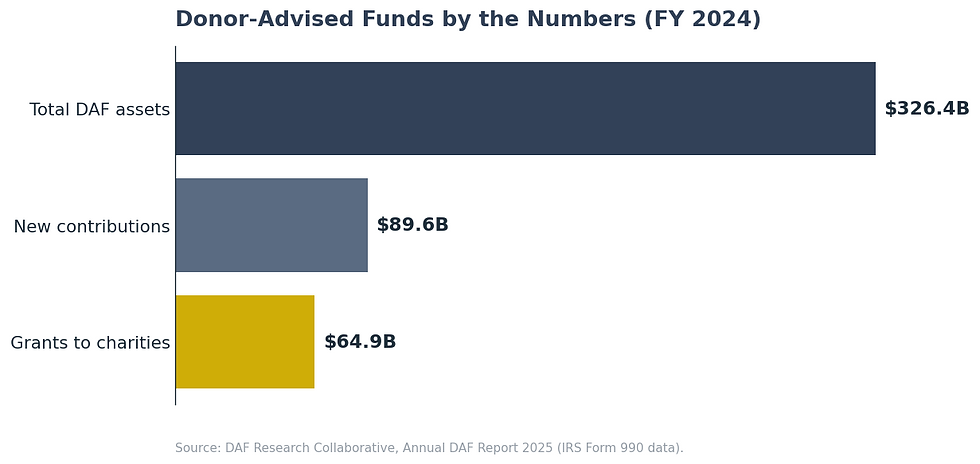
Donor advised funds now hold a staggering amount of money. By the most recent count, total DAF assets reached $326 billion across 3.56 million accounts. A lot of that will outlive the people who funded it. So this is worth a few minutes of honest thinking: what happens to your donor advised fund when you die, and how do you make sure it keeps doing what you intended?
What happens if you do nothing
Here's the part most people don't realize. A donor advised fund doesn't pass through your will the way your house or your brokerage account does. You don't legally own the money inside it anymore — you gave it away the day you funded the account. What you hold is the right to advise where grants go. That advisory right is personal to you, and when you're gone, it doesn't automatically transfer to anyone.
So if you've named no one and left no instructions, the fund becomes what the industry calls an "orphaned" account. The sponsoring organization steps in, and the remaining balance typically rolls into the sponsor's own general charitable fund, to be distributed however the sponsor sees fit. It still goes to charity, which is something. But it stops being your giving. The causes you spent years supporting may never see another dollar from it.
That's the quiet risk. Not that the money disappears, but that it drifts. A fund built to express one person's values ends up expressing a committee's. For a giver who cared deeply about specific churches, schools, or ministries, that's a real loss — and it's completely avoidable.
The choices you actually have
The good news is that fixing this is simple, and you have more options than most people expect. A donor advised fund gives you a few clear ways to say what happens next, and you can usually combine them.
The most common path is to name a successor advisor. This is a person — often a spouse, an adult child, or a few of them together — who inherits your advisory role. After you're gone, they work with the sponsor to keep recommending grants from the fund, continuing the giving you started. Families sometimes use this to pull the next generation into the habit of generosity, letting siblings or grandchildren advise a shared fund together.
There's a limit worth understanding, though. A donor advised fund is not built to pass down generation after generation forever. Most sponsors will let you name one or two rounds of successors, and after the last named advisor is gone, the remaining assets convert to another fund type or follow your final instructions. If you want giving that truly runs in perpetuity, that's a conversation about whether a private foundation or a different structure fits your goals better.
If you'd rather the fund finish its work rather than continue indefinitely, you have three more options:
- Name charitable beneficiaries. You can leave a standing recommendation directing the full balance to one or more specific charities when you pass — a clean way to make sure the organizations you love receive a final, meaningful gift. - Split the difference. Direct part of the fund to a successor advisor and part to named charities, so some giving continues and some lands immediately. - Set up an endowment-style schedule. Some sponsors let you establish recurring grants that pay out a set amount each year, so a favorite ministry receives steady support long after you're gone.
One guardrail to keep in mind across all of these: the IRS prohibits a donor advised fund from providing any personal benefit to you, your advisors, or your family. A successor can't pay themselves from the fund or use it for anything but qualified charities. The advisory role is a stewardship role, not an inheritance in the usual sense — and that's worth explaining clearly to whoever you name.
Which of these paths fits depends on your family, your causes, and what you want your giving to say after you're gone. A short conversation can help you see the options side by side and choose the one that actually matches your intent.
Book a Clarity Call — 30 minutes with a Partner, your numbers and your wishes on the table, no pitch and no pressure to act.
Making the plan match what you actually want
Naming a successor or a charity is the mechanical part. The deeper work is making sure your donor advised fund fits inside the rest of your estate, so the whole picture reflects what you care about.
Start with this reframe. Every estate eventually pays out to some mix of family, government, or charity, and you get more say in that split than most people use. Your donor advised fund is one of the cleanest tools for steering money toward charity on purpose instead of by default. But it works best when it's coordinated with everything else, not treated as a side account.
A few moves make a real difference here:
- Name your DAF as a beneficiary, not just a donor. You can list your donor advised fund as the beneficiary of a retirement account like an IRA or 401(k). Heirs who inherit those accounts often owe income tax on the withdrawals, while a charity receives them tax-free. Pointing the most heavily taxed dollars toward your fund, and leaving gentler assets to your kids, can stretch the same estate much further. - Decide whether to continue or complete. If your heart is in keeping family involved, lean toward a successor advisor. If it's in finishing strong for specific causes, lean toward named charitable beneficiaries. There's no wrong answer — only the one that matches you. - Coordinate with the rest of the plan. A donor advised fund pairs naturally with other tools. Some families replace the wealth they give away by using life insurance, so generosity to charity doesn't come out of the kids' inheritance. Others compare a fund against a charitable trust to see which structure carries their goals best.
There's a stewardship truth underneath all of this. Scripture frames everything we hold as something entrusted to us for a season, and a faithful steward thinks about the handoff, not just the holding. "Moreover, it is required of stewards that they be found faithful" (1 Corinthians 4:2, ESV). Deciding where your giving goes after you're gone isn't morbid. It's one of the most caring, clear-eyed things a steward can do.
Curious how the pieces fit together — how much could flow to charity, to your heirs, and away from unnecessary tax? Our DAF Calculator lets you model the numbers before you ever make a decision.
Run your own numbers with the Sage & Main DAF Calculator.
Write it down while it's still your choice
Most of the people sitting on unplanned donor advised funds aren't careless. They're generous, busy, and reasonably assume they'll get to it. But an advisory right you never assigned simply ends with you, and the giving you built so faithfully gets handed to a default you never picked.
The fix takes one afternoon. Log into your sponsor's portal, find the succession section, and name who or what comes next. Tell your spouse and your kids what you decided and why — that conversation often matters more than the form itself. If your fund is part of a larger estate, make sure it's coordinated with the wealth you're already planning to pass on so nothing works against itself.
You spent years deciding where your generosity would go while you were alive. Spend one more afternoon deciding where it goes after. That single choice is the difference between giving that ends with you and giving that keeps speaking in your voice long after you're gone.
Luke Lyles is a Partner at Sage & Main who works with business owners, families, and their advisors to turn intentions on paper into plans that are actually funded.


Comments